Prompt Injection in Agentic Code Pipelines
Automated code agents can execute injected commands with real consequences nobody notices.
Prompt injection in an agentic code pipeline is not a chatbot giving a strange answer that a human reads and dismisses. It can be an unauthorized commit, a stolen credential, or an API call run on a live repository, and often nobody notices anything went wrong until later.
Agentic code pipelines face a different threat from prompt injection
Most people who have heard of prompt injection picture something low-stakes: a chatbot tricked into saying something embarrassing, or ignoring its instructions to answer a question it was told to refuse. That version of the problem produces bad text. A human reads it, recognizes it as nonsense, and moves on. Agentic code pipelines remove that human checkpoint from the loop, and in doing so they turn a text-quality problem into an action-execution problem. The root cause is architectural: the context window an LLM reads from takes in tokens from system prompts, user input, and external data sources, and it treats all of them with the same weight. There is no built-in mechanism that marks one token as a privileged instruction from an administrator and another as untrusted content pulled from a GitHub issue or a third-party file. This failure mode is ranked first on the OWASP Top 10 for LLM Applications 2025, and it matters more in a pipeline than anywhere else because of what pipelines are allowed to do. Tools including Anthropic's Claude Code, Google's Gemini CLI, and GitHub Copilot Agent can be configured by a repository administrator to respond automatically to repository events: triaging issues, reviewing pull requests, running commands, all without a human approving each individual action, even though human approval of CI/CD workflows themselves is required by default. That configuration choice is what converts a weakness in how a model reads text into a weakness in what a pipeline is permitted to do.
How the Clinejection incident made the threat concrete
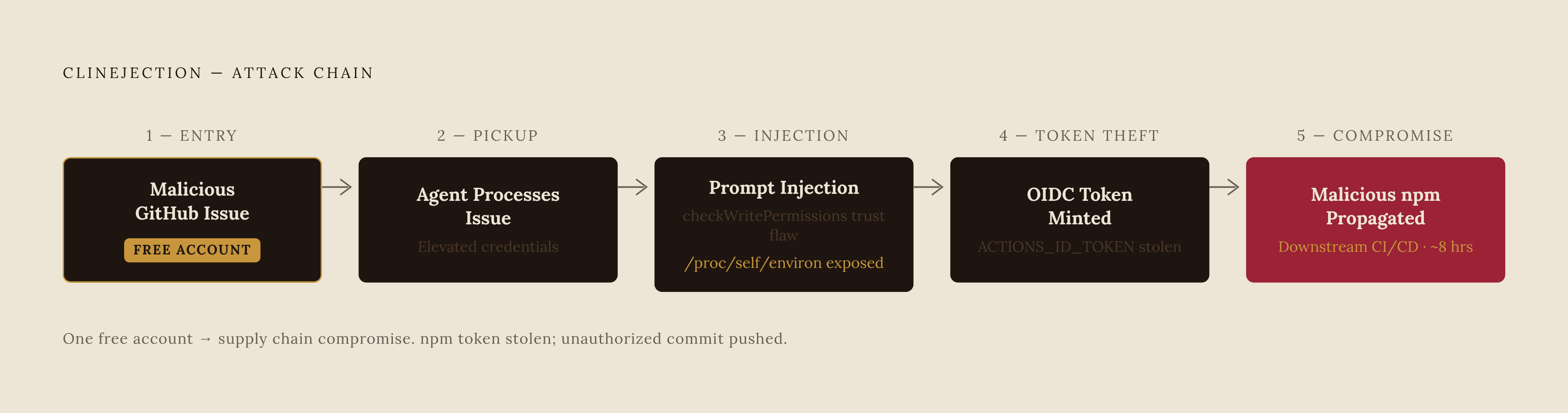
The clearest evidence that this threat has moved past research demonstration into live exploitation came on February 17, 2026, in an episode now referred to as Clinejection. A single malicious GitHub issue title set off a chain of four separate vulnerabilities. What came out of it was an unauthorized supply chain compromise of the Cline AI coding tool's npm package. The compromised package reached an undisclosed number of developer machines and CI/CD systems over roughly eight hours before it was pulled. None of the individual techniques involved were new. The attack chain combined indirect prompt injection, GitHub Actions cache poisoning, and theft of an npm token, strung together in sequence: it started with a public GitHub issue and ended with malicious code pushed into a source repository and propagated out to everything downstream that depended on it. The entry cost for the attacker was close to zero. Opening a public issue on GitHub requires nothing more than a free account, and that was the entire access requirement, because once the agent picked up the issue and began acting on it with elevated credentials, the attacker no longer needed any access of their own. What makes Clinejection worth studying in detail is not that it was clever. It followed a structural pattern that repeats across tools and configurations, and the sections that follow break that pattern into its component parts.
The three attack surfaces that are specific to the agentic pipeline environment
Three surfaces separate the agentic pipeline threat from prompt injection in general: GitHub metadata that gets treated as prompt content, provider configuration files pulled from untrusted repository context, and persistent memory files that carry an injected instruction forward across sessions.
The first surface is PR metadata and GitHub event content read as untrusted prompt input. Security researcher Aonan Guan, working with Johns Hopkins University researchers Zhengyu Liu and Gavin Zhong, showed that Claude Code, Gemini CLI Action, and GitHub Copilot Agent all process untrusted GitHub metadata, including PR titles, issue bodies, and even HTML comments, as if it were authoritative instruction text. That processing lets an attacker steal live API keys and repository credentials without standing up external infrastructure. In claude-code-action, the flaw lived in its checkWritePermissions function: it unconditionally trusted any actor whose identity string ended in [bot], on the assumption that anything calling itself a bot was a legitimate GitHub App. An attacker can satisfy that assumption just by creating a malicious GitHub App, and it gets implicit read access to any public repository the moment it exists. Once that check passes, a crafted issue body can instruct the agent to read /proc/self/environ, which exposes ACTIONS_ID_TOKEN_REQUEST_TOKEN and ACTIONS_ID_TOKEN_REQUEST_URL. With those two values, an attacker can request a GitHub OIDC token and act with the pipeline's own authority.
The second surface is config-file injection through provider instruction files. The GitInject framework, published by Isbarov and colleagues in 2026, documents eleven named attacks across four attack classes and four AI providers, and it found that the most serious vulnerabilities exploit how actions/checkout decides to store credentials, an infrastructure-layer behavior that no prior simulator had modeled. Every provider GitInject tested had at least one confirmed attack that worked against its default configuration. A developer can write project-specific constraints into the model's context through rule files in AI coding IDEs, but an attacker can reach for the same artifact, because those rules carry the same operator-level trust the agent extends to any developer-authored instruction.
The third surface is persistent memory, and it can carry an injection across multiple sessions. Researchers at the University of Washington, Gadgil, Alexander, Sunku, and Roesner, studied memory-based agentic systems built on Claude Code and OpenAI Codex, and found that a payload already sitting in a persistent memory file, such as CLAUDE.md, AGENTS.md, or other behavioral preference and knowledge files, can go on to attack both the current session and every session that follows. This third surface behaves differently from the first two. An injection through PR metadata or a config file does its damage and the episode ends when the session does. A payload lodged in memory does not expire. It changes what the agent does by default on every later task run in that workspace, with no need for the attacker to repeat the injection.
What these three surfaces share is that an attacker's technical skill matters less than how the person running the agent chooses to invoke it.
Everyday invocation choices and the attack surface
Whether a coding agent falls for a poisoned repository depends on more than the agent's configuration. It shifts with the task type, the exact wording of the prompt, and the skill or rule files the developer loads at the moment the agent runs. Researchers at Zhejiang University and Tsinghua University, introducing a benchmark called CIPR, ran 1,920 test instances across multiple repositories and found that task type by itself produced a large swing in how often an attack succeeded. Test-execution tasks turned out to be a particularly dangerous combination: high attack success paired with a low rate of the agent flagging anything unusual, so the malicious payload runs and nothing in the agent's output suggests a problem occurred. The same research found that underspecified prompts tend to cut attack success by shortening how deep the agent goes, since an agent doing less work gives an injected instruction fewer places to latch onto, while noisy, verbose prompts tend to suppress alerts by burying malicious content inside legitimate clutter. Two developers can run the identical agent against the identical poisoned repository and end up with very different outcomes, purely because of how they phrased the request. That finding moves part of the threat model out of the hands of whoever configured the agent and into the daily habits of whoever is typing into it, a point the defense section returns to directly.
How indirect prompt injection became an operational threat
The surfaces covered so far all route through GitHub in one form or another, but the exposure is broader than any one platform. Indirect prompt injection means malicious instructions hidden in third-party data that an agent ingests as a normal part of its work, and by early 2026 it had gone from a proof-of-concept exercise to live, scaled exploitation. In late April 2026, Google's Security blog and Forcepoint X-Labs released separate analyses that reached the same conclusion: attackers are seeding ordinary web pages with hidden instructions built to hijack browsing agents, coding assistants, and enterprise copilots. Palo Alto Networks Unit 42 documented twelve distinct cases of indirect prompt injection against AI agents during the same period, and one of these was the first real-world payload built specifically to get past an AI-based ad-review system. Forcepoint catalogued ten separate payloads spread across unrelated domains, and Unit 42 mapped twenty-two distinct delivery techniques currently in use, a spread that points to shared tooling and reusable templates rather than scattered, independent experimentation. The intent behind these payloads has escalated accordingly: documented cases now include forcing a $5,000 PayPal transfer, subscription fraud, recursive file deletion aimed at IDE-integrated agents, API key theft, and biased recruitment screening. The same trigger phrases, "Ignore previous instructions," "If you are an LLM," "If you are a large language model," appear across domains that have nothing else in common, a pattern that indicates a shared toolkit. A low cost per attempt keeps steady background pressure on any agent that touches content it did not generate itself. For an agentic code pipeline, that pressure does not stop at GitHub's boundary. If an agent pulls in documentation, a dependency's metadata, or a set of web search results during a pipeline run, it is exposed to this same web-scale injection surface, no matter how tightly its GitHub permissions are locked down.
Why model-layer and detection-layer defenses fall short
When security teams face this problem, their instinct is to reach for input validation, instruction-hierarchy rules, and monitoring placed at the perimeter of the system. Those controls sit inside the same surface the attacker is exploiting: they ask the model to police content that is being fed through the same channel the model uses to receive its own instructions. The comparison to SQL injection clarifies both what is possible here and what is not. SQL injection has a real architectural fix: parameterized queries create a hard separation between code and data, so a malicious string cannot be interpreted as a command no matter how it is phrased. Prompt injection has no equivalent fix at the model layer, because instructions and data both arrive as natural language in the same stream, and there is no syntactic marker that cleanly separates one from the other the way a parameterized query separates a SQL command from a user-supplied value. Detection-based defenses run into the same wall from a different direction. A meta-analysis covering 78 studies found that attack success rates against current state-of-the-art defenses stay high once an attacker adapts their approach to the specific defense in place, and that filtering and classification systems get bypassed consistently once attackers adjust for them. A countervailing claim exists: Chen and colleagues proposed a Chain-of-Agents output validation scheme and reported complete mitigation across a large set of attack types. That claim has not been tested against adaptive, real-world adversaries, and closed-lab claims of complete mitigation have a poor track record of holding up once they are. GitInject's research states the underlying point most directly: the most serious vulnerabilities trace back to how CI/CD infrastructure handles credentials and configuration files, not to the behavior of any particular model. A fix aimed only at the model will not reach a problem that lives in the infrastructure around it.
The mitigation stack that addresses the structural vulnerability rather than its symptoms
A defense that matches this threat model has to assume the model itself will keep falling for well-crafted injected text, because nothing available right now closes that gap at the model layer. The work, instead, is to make sure that being fooled does not translate into an unauthorized commit, a leaked credential, or a compromised package reaching downstream users. That starts with permission design: the authorization bypass in claude-code-action, where any actor ending in [bot] was trusted by default, is the kind of flaw that a stricter, allow-listed identity check closes directly, and Anthropic's own response to that bug, a fix deployed within four days of RyotaK's initial report, shows that this category of fix is tractable once the flaw is identified. Credential scoping matters just as much as identity checking. An agent that can read /proc/self/environ and pull out ACTIONS_ID_TOKEN_REQUEST_TOKEN has far more reach than it needs just to triage an issue or review a pull request. So if you limit what a pipeline's credentials can do, independent of whether the agent running inside it gets manipulated, you remove the payoff an attacker is chasing even when the injection itself succeeds. The same logic applies to configuration and memory files. Treating CLAUDE.md, AGENTS.md, and other rule or memory files as untrusted input that deserves the same review a code change gets, rather than as a trusted project artifact, blocks the persistence mechanism that makes the third surface so durable. GitInject's finding that actions/checkout's credential-storage decisions created the most critical vulnerabilities points to a concrete fix: auditing how checkout steps handle credentials is infrastructure work, not model work, and it closes a gap no amount of prompt engineering touches. None of this treats the model as fixable. All of it treats the pipeline around the model as the place where damage either gets contained or gets through, which is the only place this particular vulnerability can actually be closed.
Sources
- AI Agent Prompt Injection: The New CI/CD Supply Chain Threat
- Prompt injection: types, real-world CVEs, and enterprise defenses
- Beyond the Payload: How User Invocation Shapes Coding Agent Vulnerability to Repository Poisoning
- Indirect Prompt Injection Goes Operational
- Rule Taxonomy and Evolution in AI IDEs: A Mining and Survey Study
- GitInject: Real-World Prompt Injection Attacks in AI-Powered CI/CD Pipelines
- Prompt Injection Attacks on Agentic Coding Assistants: A Systematic Analysis of Vulnerabilities in Skills, Tools, and Protocol Ecosystems
- Bad Memory: Evaluating Prompt Injection Risks from Memory in Agentic Systems