Least-Privilege Principles for AI Agent Tool Access
Agents need permissions tied to actual tasks, not broad access that spreads risk across systems.
AI agents plan, chain actions across systems, and invoke tools in sequences without a human approving each step. That behavior breaks the assumptions traditional least-privilege design rests on, which was built for principals that are either human (bounded by a login session and a person's intent) or software (fixed to a narrow, predefined set of tasks).
A human user logs in, does a task, logs out. The session has a natural edge, set by how long a person sits at a keyboard and what they came there to do. An agent has no such edge. It can move through email, files, a ticketing system, and a code repository in seconds, correlating data across all four in ways that no single connection would flag as dangerous. Microsoft's security guidance makes this point directly: an agent with access to email, files, a ticketing system, and a code repository can look low-risk at each individual integration, while the combination enables data correlation and actions that no one explicitly signed off on as a whole.
Service accounts don't close this gap either. Conventional software runs a narrow, predictable set of predefined tasks, the same operation every time, against the same endpoints. Agents interact with multiple applications, pull information from varied data sources, run commands, and kick off automated workflows, and what an agent will actually do in production is not something you can fully specify at the moment you deploy it. ThreatLocker's analysis of this gap makes a simple but important point: every permission granted to an agent expands its potential impact, and because agents operate at machine speed, mistakes and malicious activity can spread far faster than anything driven by a person clicking through steps one at a time.
There's also a second problem: who is the agent acting as? Its own identity, a scope delegated from a user, or some blend of the two? Microsoft identifies this ambiguity as the root cause of a deeper failure that becomes visible in logs only after something has already gone wrong. When the identity model doesn't resolve cleanly, logs can show which tool got called, but they can't answer who authorized the call, under what role, or whether the action stayed within the scope anyone intended. That gap is what turns an ordinary incident response into a guessing exercise, and it's what turns a routine regulatory inquiry into one where the organization cannot produce a straight answer about who was accountable for what the agent did.
How organizations grant agents access
Most organizations hand agents broad access at the point of deployment because broad access is fast, and those permissions tend to sit untouched long after the agent's job has changed. Microsoft documents the pattern in a form that will be familiar to anyone who has provisioned cloud roles before: a team sets up an agent with a broad "Reader" role because the first use case looks read-only. The workflow then grows to include writing fixes, and instead of going back to redesign the role, the team grants something wider than the job actually requires and moves on. Scope creep like this doesn't announce itself. It happens in small increments, and because nobody circles back to re-examine the grant once the immediate need is met, the permission just stays there.
Shared credentials make the problem worse. When an agent runs under a shared secret or a reused service account rather than its own dedicated identity, there's no clean audit trail tied to that agent specifically, no named owner responsible for it, and no checklist for shutting it down when it's no longer needed. The agent exists and acts, but as far as the access control system is concerned, it's effectively invisible as a principal in its own right.
Both Microsoft and AvePoint point to the same structural cause behind these patterns: organizations are rolling out agentic capabilities, multi-step automation, delegated actions, and tool use, faster than their identity and authorization models can evolve to safely contain them. This isn't a hypothetical risk sitting in a slide deck. AvePoint's State of AI 2026 Report found that a large majority of organizations experienced at least one generative AI-related security breach in the prior year. Governance gaps of the kind described above are already producing incidents, not just theoretical exposure.
What ties all of this together is a visibility problem. Security teams cannot control what they cannot see, and without a complete inventory of which agents exist, what each one is permitted to do, and what data each one can reach, there's no way to judge whether any given agent's permissions still make sense for the job it's actually doing today.
The blast radius of over-permissioned agents
When an agent carries more access than its task requires, a single point of failure can reach every system that agent touches. A misconfigured integration, a poisoned prompt, a compromised tool package: any of these can become the opening move, and the resulting damage is shaped by how much standing access the agent had, not by how sophisticated the attack itself was.
Check Point Research disclosed two vulnerabilities in Claude Code, tracked as CVE-2025-59536 and CVE-2026-21852, that allowed remote code execution and theft of API keys through poisoned repository configuration files. The exploit worked through Hooks, MCP server settings, and environment variables. Hooks in particular matter here because the feature runs user-defined shell commands at specific lifecycle events. The vulnerability lived in the tool-execution infrastructure itself, not in anything the model was told or instructed to do. That distinction is the core lesson of the incident: the attack surface for an agent includes every tool it's wired into, and a poisoned configuration file can turn a routine automation step into a credential-theft channel.
The pattern across incidents like this one is consistent. The agent's standing permissions set the ceiling on how bad things can get once something goes wrong. That is why the permission boundary deserves the scrutiny, not just the sophistication of whatever got past it.
Extending the classical least-privilege principle to cover what an agent can cause, not just what it is permitted to reach
Scoping what data an agent is permitted to read or touch is necessary, but it isn't enough on its own. Agents don't act directly on data: they act through tools, and tools can trigger consequences across many downstream systems that have nothing to do with the original data access grant. A credential that limits what an agent can reach says nothing about what that agent can cause once it invokes a tool that, in turn, triggers a script, sends a message, deletes a record, or modifies a permission somewhere else in the stack.
You cannot sandbox a large language model from the inside, because instructions placed in a system prompt can be overridden by prompt injection, since the model is reading and acting on text, and an attacker who controls part of that text can steer the model's next move. A sandbox enforced at the infrastructure or tool layer cannot be talked out of its boundaries the way a system prompt can. If that's true, then the only enforcement that holds up under an adversarial prompt is the enforcement that happens outside the model entirely, at the point where a tool call actually executes.
That argument doesn't weaken the case for least privilege. It strengthens the case for something more specific: least authority, which asks not what an agent is permitted to reach but what an agent is able to cause through the tools available to it. Scoping credentials answers the first question. Scoping tool bindings, action types, and execution boundaries answers the second, and the second question is the one that determines how bad a compromised agent can actually get.
Research backs up the idea that this gap is more than theoretical. A paper on SkillScope, from Jiangrong Wu and co-authors at ACM CCS, found that a skill can carry out high-impact actions that go beyond what a user's current task actually needs, even when the credential behind that skill is technically authorized to perform the action. The permission was valid. The action was still wrong for the task at hand. A static permission profile cannot catch this shape of problem: the question isn't whether access was granted, it's whether the action fit the task, and that fit changes from one task to the next even when the identity making the call stays the same.
The implication for where enforcement needs to live follows directly from this. If the risk is what an agent can cause through a tool, then the tool layer, not the identity layer alone, is where causal reach has to be constrained. Identity answers who is acting. Tool-layer controls answer what that identity is allowed to do right now, for this task, and that second layer is where the architecture described in the rest of this piece is built.
Conventional software runs a narrow, predictable set of predefined tasks, the same operation every time, against the same endpoints.
Task-conditioned permissions as the answer to the static-profile problem
The same tool call that's perfectly reasonable under one task can be dangerously over-scoped under another, even when it's the same agent making the call with the same underlying credential. A write operation to a customer record is routine during a remediation workflow and alarming during a read-only research task. Because the risk of any given action depends on the task it's attached to, the right unit for access control is the task. Permissions should be granted by task type, applied dynamically when the task starts, and pulled back automatically when the task ends.
In practice, this means access gets defined around what the current task needs rather than bolted permanently onto the agent's profile. A research agent reading through documents needs read access to those documents and nothing past that. The moment that same agent shifts into a remediation workflow, writing fixes, updating records, closing tickets, it needs a different, separately gated set of write permissions, granted for that workflow and nothing else. miniOrange describes this as task-based access: permissions shift based on what the agent is currently doing, instead of being assigned once, permanently, to the agent itself.
The SkillScope research gives this architectural choice real weight. Researchers validated over 7,000 skills with over-privileged behaviors across production skill ecosystems, which on its own confirms the problem isn't rare or theoretical. More importantly, they found that a privilege-constraining evaluation approach cut the number of triggered over-privileged action-in-task instances by a large margin, while still letting legitimate tasks finish normally. Fine-grained task conditioning works, and it doesn't come at the cost of breaking the workflows it's meant to protect.
There's an obvious objection to all of this, and it has to be answered directly. Scoping permissions this tightly seems to require knowing, in advance, what actions a task will demand, but agents exist precisely because their moment-to-moment behavior is hard to fully specify ahead of time. Scope something too narrowly and the workflow breaks mid-execution when the agent needs one more permission it wasn't granted.
Task-conditioned privilege means granting permission by task type, not prompt by prompt. An organization defines an access profile for a category of work, read-only knowledge retrieval, draft ticket creation, code review without merge rights, and grants that whole profile for the duration of any task that falls into that category. Individual prompts within a task are unpredictable. The category of task is not, and that's the level at which specification actually holds up. Microsoft's own recommendation points the same direction: build roles around the smallest meaningful unit of work, and avoid bundling unrelated permissions into one grant just because it's operationally convenient.
Separation of duties still applies at this level, and it matters most when a single workflow spans both low-risk and high-risk actions. When a task includes evidence gathering and remediation, Microsoft recommends using different roles, or different tools entirely, for read versus write operations, and gating the genuinely high-impact actions, deletion, export, privilege changes, behind a step-up approval that requires something beyond the agent's standing grant.
The four technical controls that make dynamic least-privilege operational
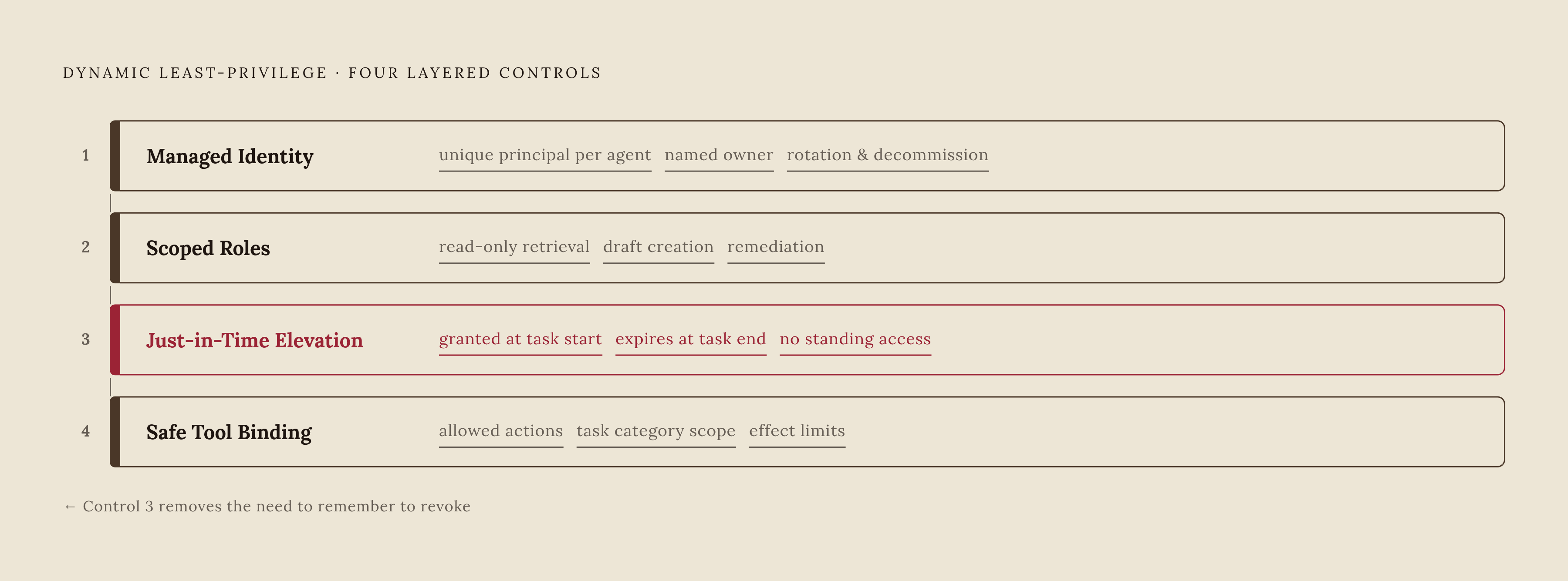
Dynamic least-privilege is a layered set of controls, working together, that keep access traceable, bounded, time-limited, and restricted to the specific actions a task actually calls for. Four controls make up that layer: managed identities, scoped role-based access, just-in-time elevation, and safe tool binding.
The first control is a managed, dedicated identity for every agent. Each agent needs its own unique principal, never a shared secret, never a reused service account borrowed from some other system, with a named human owner attached to it and an explicit statement of what that agent exists to do. That identity needs a full lifecycle: onboarding checks when it's created, regular credential rotation while it's active, a suspension path if something looks wrong, and a decommissioning process for when the agent is retired. Microsoft recommends building this lifecycle in from day one rather than retrofitting it later, including a shutdown mechanism that actually invalidates the agent's credentials and tokens rather than just disabling a dashboard entry while the underlying access quietly remains live.
The second control is scoped, role-based access defined around task categories. Instead of granting an agent a general-purpose "Reader" or "Contributor" role across an entire environment, the role gets built around the specific category of task the agent performs, read-only retrieval, draft creation, remediation, and nothing wider than that category requires. This is the architectural piece that makes the task-conditioned model from the previous section enforceable rather than aspirational: the role itself encodes the boundary, so the boundary doesn't depend on anyone remembering to check it later.
The third control is just-in-time elevation. Rather than granting standing permissions that sit active all the time whether or not the agent is using them, access gets elevated only when a task that needs it actually starts, and it expires automatically when that task ends. A permission granted for a two-hour remediation task shouldn't still be live a month later simply because nobody revoked it. Time-bounding the grant removes the need for anyone to remember to revoke it.
How organizations currently grant access to agents Binding an agent to a tool needs to specify not just that the agent can call the tool, but which actions within that tool are permitted, under which task categories, and with what limits on downstream effect. A tool binding that allows an agent to read a ticket is a different grant from one that allows it to close a ticket, and a tool binding that allows it to close a ticket is a different grant again from one that allows it to delete a repository configuration file. Binding access at this level of specificity is what stops a compromised or misdirected agent from reaching past the task it was given, even when the identity making the call and the role attached to that identity both check out on paper.
Together, these four controls turn least-privilege from a static grant made once at deployment into a live, continuously enforced boundary that tracks what an agent is actually doing rather than what it was once assumed it might need to do.
Sources
- Least privilege for AI agents: Identity, access, and tool binding
Provided Microsoft's security guidance on agent identity ambiguity, scope creep patterns, role design recommendations, and the Claude Code CVE disclosures referenced throughout the article.
- SkillScope: Toward Fine-Grained Least-Privilege Enforcement for Agent Skills
Supplied the SkillScope research findings on over-privileged agent skills and the validation of fine-grained task-conditioned permission enforcement across production skill ecosystems.
- Least privilege for AI agents with Microsoft Entra Agent ID
Provided Microsoft's technical recommendations on managed identities, lifecycle management, role scoping, just-in-time elevation, and tool binding specificity for AI agents.